News
On 17 July 2026, TaxDev and the Ethiopian Economic Association (EEA) co-organised a panel discussion, “Beyond Aid: Tax Policy Reforms as a Path to Sustainable Financing”, as part of the EEA’s 23rd International Conference on the Ethiopian Economy in Addis Ababa. The session brought together government officials and researchers to discuss how Ethiopia can sustain its recent progress in domestic revenue mobilisation (DRM) at a time when official development assistance to low-income countries is falling sharply.
Opening the session, Laurin Janes, Senior Economist at the British Embassy Ethiopia, pointed to the recent fall in aid flows and the corresponding need to strengthen DRM.
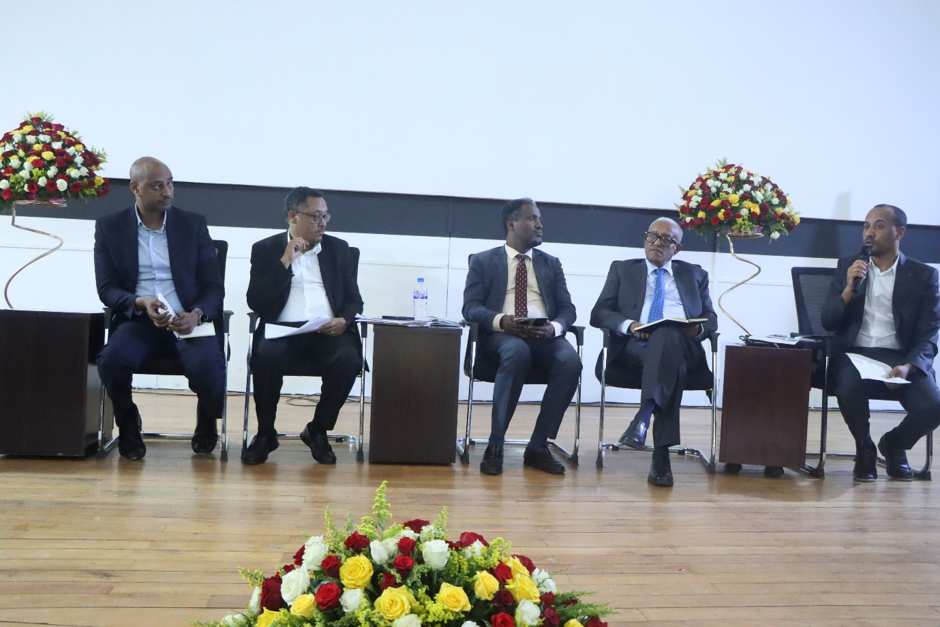
The panel in discussion (from left): Tewodros Mekonen, Tiruneh Legesse, Mulay Weldu, Wassihun Abate and Edris Seid (chair).
Chairing the session, Edris Seid, TaxDev Country Economist and Programme Manager for Ethiopia, set out the puzzle motivating the panel. Despite average GDP growth of around 8% over the past decade, Ethiopia’s tax-to-GDP ratio had moved in the opposite direction to what might be expected, falling from 12.7% in FY 2014/15 to just 6.2% in FY 2023/24 – one of the largest relative declines recorded anywhere in the world over that period and well below regional peers such as Kenya, Rwanda and Uganda.
He pointed to a marked turnaround since then: the tax-to-GDP ratio rose to 7.8% in FY 2024/25 and is projected to reach around 9.5% by the end of FY 2025/26. This turning point, he said, was what made the discussion timely, and he framed the panel around four questions: what is driving the recent reversal; how much of it reflects durable reform rather than one-off gains; what the evidence so far suggests about which factors matter most; and how much further this can realistically go – including whether Ethiopia can reach the 15% tax-to-GDP threshold that the IMF has identified as a benchmark to accelerate growth and finance the sustainable development goals.
Edris noted that research on Ethiopia’s earlier revenue shortfall suggests it split roughly into two parts: one structural, reflecting factors such as the size of agriculture in the economy, low urbanisation and income levels; and policy and administrative choices. He framed the panel’s task as reflecting on what drives the recent turnaround, and what it will take to sustain it – drawing on perspectives from policymakers at the Ministry of Finance and the Ministry of Revenue alongside researchers from academia and IGC.
Mulay Weldu, Head of the Tax Policy Department at the Ministry of Finance, attributed the recent improvement in Ethiopia’s tax-to-GDP ratio to a comprehensive, whole-of-government approach to reform. He set out a series of tax policy measures introduced over the past two years, including broadening the tax base, removing ineffective exemptions (particularly on VAT), rationalising tax expenditures – for example replacing tax holidays with reduced rates – narrowing the sectoral coverage of tax incentives to focus on genuinely strategic sectors, and simplifying the previously complex presumptive tax regime.
These policy changes, he said, were complemented by administrative measures, including digitisation of tax administration, and made effective by sustained political commitment: the Prime Minister’s Office established a Tax Reform Taskforce, chaired by the Senior PM Advisor, to oversee implementation.
Tiruneh Legesse, Head of the Tax Transformation Office at the Ministry of Revenue, described a range of administrative measures aimed at balancing revenue mobilisation with modernisation. Of the 19 administrative measures set out in the National Medium-Term Revenue Strategy (NMTRS), 18 have already been implemented. Regular TADAT assessments are now being conducted, alongside a national diagnostic exercise. The Ministry is also working to make services more accessible – including through new channels such as call centres – while rolling out e-invoicing and developing a mobile application.
Wassihun Abate, Senior Advisor at the Ministry of Finance, reflected on policymakers’ readiness for tax reform across three different regimes. In his assessment, while previous governments had introduced meaningful reforms, the current government has been notably more aggressive in pursuing tax system reform. He concluded that there is strong interest and momentum for reform under the current administration.
Returning to Edris’ opening question of how far Ethiopia can realistically go – and specifically whether the 15% threshold is within reach – Mulay Weldu set out his response.
He first explained why raising the tax-to-GDP ratio matters, describing tax as the engine of the whole government. He noted that a 15% ratio has been identified by the IMF as a benchmark associated with higher economic growth and pointed to strong performance over the past two fiscal years as grounds for confidence that Ethiopia can reach this target within the next couple of years. He added that the government’s ambitions extend further still, towards Ethiopia’s estimated tax potential of around 19% of GDP, with a rigorous evaluation of tax incentives identified as a near-term priority.
Dr Tewodros Mekonen, Country Manager at the International Growth Centre (IGC) Ethiopia, drew on IGC’s research to identify reform areas with significant revenue-raising potential. On the policy side, he highlighted land and agriculture-related taxes. On the administrative side, he pointed to several under-leveraged tools: electronic billing machines, which were rolled out some time ago but remain underused owing to limited staff capacity dedicated to tax administration; consumer incentive schemes such as rebates or lottery-based incentives, which have raised significant revenue in other countries; risk-based auditing; and better use of available third-party information.
He also cited a striking finding from a recent government report: around 10% of taxpayers accounted for approximately 90% of tax revenue in FY 2021/22 – reinforcing, as Mulay Weldu had noted earlier, the importance of broadening the tax base. He further flagged a structural trend for policymakers to watch: as labour shifts away from agriculture towards the informal service sector, tax policy will need to adapt to bring this segment into the tax system.
Dr Tewodros closed by noting that the pace and scale of Ethiopia’s current reforms are rarely seen, presenting a valuable opportunity for local researchers to study their impact. He encouraged researchers to work closely with policymakers to examine these reforms in real time.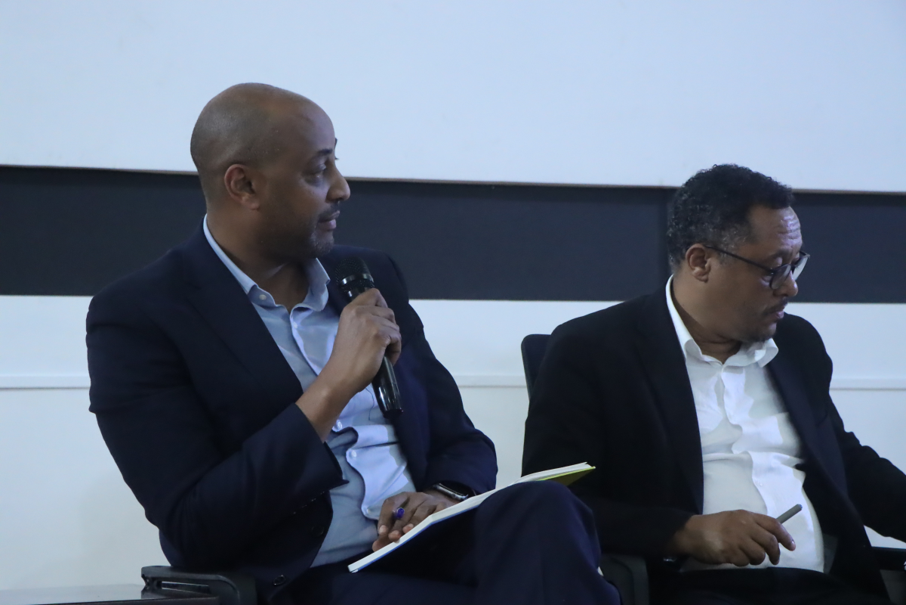 Dr Tewodros Mekonen presenting during the panel discussion.
The panel underscored both the extent of Ethiopia’s recent progress in domestic revenue mobilisation and the scale of the task that remains in sustaining it. Speakers were consistent in linking recent gains to a combination of policy reform, administrative modernisation and political commitment, while pointing to base broadening, land and agricultural taxation, and better use of data and technology as key areas for further work. As external financing continues to decline, panellists agreed that continued research and close collaboration between policymakers and researchers will be important in guiding the next phase of reform.
Read more about the event: EEA panel discussion | Beyond aid: tax policy reform as a path to sustainable development financing
Published on: 28th July 2026
Print